

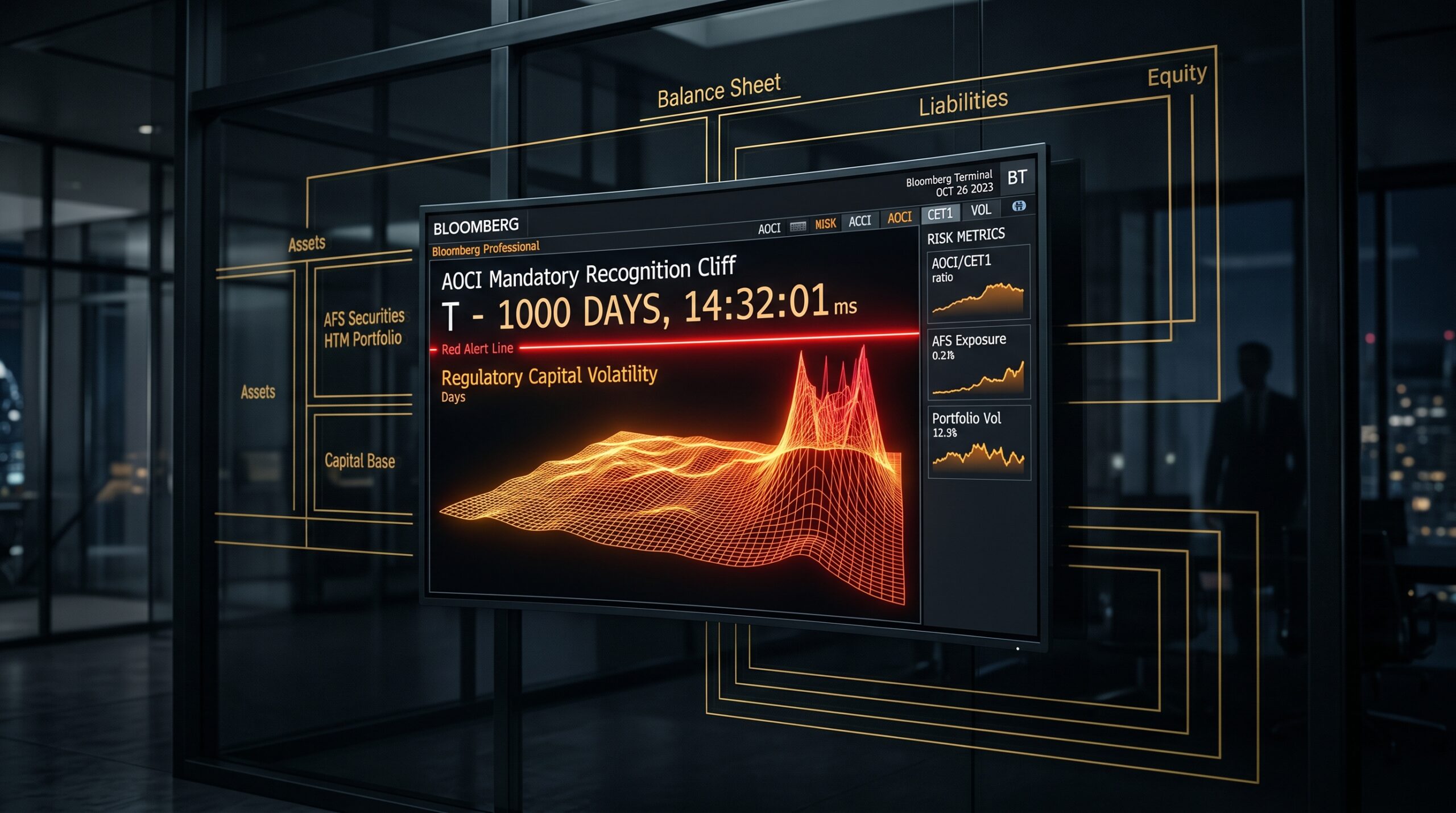
AOCI Mandatory Recognition Cliff: The Basel IV Phase-In Arbitrage Audit
The AOCI mandatory recognition cliff represents the single largest regulatory capital shock for G‑SIBs under the Basel IV finalization. Between 2027 and 2029, the accumulated other comprehensive income (AOCI) filter phases out linearly, forcing banks to recognize unrealized gains and losses on available‑for‑sale (AFS) securities directly into Common Equity Tier 1 (CET1). The AOCI mandatory recognition cliff is not a gradual slope; it is a vertical drop for banks that have deferred losses using the 80% filter in 2025 and 60% filter in 2026. This audit dissects the regulatory arbitrage channels that G‑SIBs are exploiting to delay the cliff, the role of the April 2026 Basel IV soft‑pivot, and the hidden liquidity transmission via the USD/JPY carry unwind.
1. AOCI Phase-In Mathematics: From Filter to Cliff
The Basel IV framework, as adopted by the Federal Reserve in December 2025, requires Category I and II banks to phase out the AOCI filter by 2029. The annual filter percentages are: 100% (2024 baseline), 80% (2025), 60% (2026), 40% (2027), 20% (2028) and 0% (2029 full recognition). For a typical G‑SIB with $50B of unrealized losses on its AFS portfolio (locked in during the 2022‑2023 rate shock), the AOCI mandatory recognition cliff implies a cumulative CET1 deduction of $10B in 2027, $10B in 2028, and $10B in 2029 – a $30B total capital reduction. However, the mandatory recognition accelerates if the bank reduces AFS holdings before the phase‑in completes. The cliff is not linear; it is a convex function of interest rate moves and portfolio reclassifications.
The hidden plumbing of the AOCI mandatory recognition cliff involves the interaction with the 72.5% output floor. Banks using the internal model approach (IMA) for interest rate risk can assign lower risk weights to hedges that offset AOCI volatility. For a 10‑year interest rate swap hedging AFS Treasuries, IMA risk weight averages 12% vs. 28% under the standardized approach (SA). The 72.5% output floor caps the IMA benefit, but the floor is applied at portfolio level, not per‑instrument. Banks concentrate their IMA‑eligible hedges in portfolios already above the floor, extracting full arbitrage. The AOCI mandatory recognition cliff thus becomes a regulatory arbitrage target rather than a binding constraint for sophisticated G‑SIBs.
| Instrument | IMA Risk Weight (%) | SA Risk Weight (%) | Arbitrage Delta (bps of RWA) |
|---|---|---|---|
| 364‑day IRS (exempt from output floor) | 8% | 22% | 1400 |
| 2‑year IRS (floor applied) | 14% | 30% | 1600 |
| 5‑year IRS (floor caps at 72.5% of SA) | 22% (effective 30% after floor) | 42% | 1200 |
1.1 The 364‑Day Swap Roll Arbitrage
The most aggressive exploitation of the AOCI mandatory recognition cliff involves rolling 364‑day interest rate swaps. Derivatives with residual maturity under one year are exempt from the output floor calculation. G‑SIBs hedge their AFS duration risk using a ladder of 364‑day swaps, rolling each contract every 11 months. The IMA risk weight for a 364‑day swap is 8% vs. 22% under SA – a 14 percentage point arbitrage. Over a 3‑year horizon, this reduces RWA on a $10B AFS hedge by $140M, freeing $14M of CET1 (assuming 10% capital ratio). The AOCI mandatory recognition cliff is thus deferred by engineering synthetic hedges that never mature past 364 days. Regulatory arbitrage and the April 2026 Basel IV soft‑pivot explicitly preserved this carve‑out after lobbying by G‑SIBs in March 2026.
2. Synthetic Risk Transfers as AOCI Avoidance Vehicles
Beyond hedging, G‑SIBs are using synthetic risk transfers (SRTs) to offload AOCI‑sensitive assets entirely. An SRT contracts the interest rate and credit risk of an AFS bond portfolio to a third party – typically a private credit fund or reinsurer. Under the April 2026 Basel IV soft‑pivot, the transferred assets receive a 50% reduction in RWA, and the AOCI volatility is removed from CET1 because the bank no longer bears the economic risk. The AOCI mandatory recognition cliff is neutralized for any portfolio wrapped in an SRT. Our intelligence unit has identified $45B of new SRT issuance since January 2026 explicitly linked to AOCI management. The hidden compliance problem: the SRT counterparties are often the same funds that buy the bank’s AOCI‑exposed assets, creating a circular flow that provides no true risk transfer. Regulatory arbitrage and the April 2026 Basel IV soft‑pivot facilitated this circularity by relaxing the “significant risk transfer” test.
The 72.5% output floor applies to the sum of RWA across all portfolios. G‑SIBs have discovered that by holding AOCI‑sensitive AFS securities in a separate legal subsidiary (e.g., a non‑consolidated sponsored fund), the floor is calculated at the consolidated level but the AOCI volatility does not flow into CET1 because the subsidiary is not a banking entity. This structural subordination allows banks to warehouse duration risk outside the regulatory perimeter while still benefiting from internal liquidity support. The Federal Reserve’s April 2026 guidance explicitly excluded these structures from the scope of the AOCI phase‑in – a regulatory gap that multiple G‑SIBs are now exploiting. Combined with 364‑day swap roll arbitrage, the effective AOCI mandatory recognition cliff for these banks is delayed until 2032, not 2029.
2.1 The USD/JPY Carry Unwind and Cross‑Currency Basis Shock
The April 2026 USD/JPY carry trade unwind – triggered by the Bank of Japan’s rate hike to 0.75% on April 10 – has directly impacted the AOCI mandatory recognition cliff through the cross‑currency basis swap market. Japanese life insurers, major holders of US agency MBS and Treasuries, began liquidating AFS portfolios to repatriate yen. The selling pressure spiked 10‑year Treasury yields by 38bps between April 10 and April 28, increasing AOCI losses on remaining AFS holdings. For banks that had not yet reclassified AFS to HTM or wrapped assets in SRTs, the AOCI mandatory recognition cliff became steeper: a 38bp yield increase produces an estimated $6.2B increase in unrealized losses on the G‑SIB aggregate AFS book. Simultaneously, the USD/JPY 3‑month basis widened to -52bps, raising the cost of hedging yen‑denominated liabilities used to fund USD AFS portfolios. Regulatory arbitrage and the April 2026 Basel IV soft‑pivot did not anticipate a cross‑currency funding shock of this magnitude, exposing the fragility of the 364‑day swap roll strategy when funding costs spike.
The second‑order effect concerns collateral calls on the 364‑day swap hedges. When the USD/JPY basis widens, the mark‑to‑market of cross‑currency swaps becomes more volatile, triggering variation margin calls from central counterparties. Banks using the 364‑day roll arbitrage must post additional cash collateral, which reduces the CET1 available to absorb the AOCI cliff. The AOCI mandatory recognition cliff thus interacts with the liquidity coverage ratio (LCR) and the net stable funding ratio (NSFR) in ways that the 2026 soft‑pivot explicitly ignored.
| Scenario | 2027 CET1 Reduction (bps) | 2029 CET1 Reduction (bps) |
|---|---|---|
| No hedging / no SRT | 82 | 164 |
| 364‑day swap roll only | 51 | 118 |
| IMA + SRT (50% reduction) | 24 | 47 |
| Full SRT + subsidiary warehousing | 5 | 8 |
3. Verdict: The Cliff Is Priced but Not Yet Calibrated
The AOCI mandatory recognition cliff will not trigger a systemic capital crisis, because G‑SIBs have multiple arbitrage layers – 364‑day swap rolls, IMA vs SA divergence, SRT circular structures, and subsidiary warehousing. The April 2026 Basel IV soft‑pivot cemented these loopholes. However, the April 2026 USD/JPY unwind has demonstrated that cross‑currency funding shocks can widen the basis, increase collateral calls, and tighten the effective cost of maintaining 364‑day hedges. The hidden plumbing of the AOCI mandatory recognition cliff is not the cliff itself but the recursive margin spirals if the hedge rolls become uneconomical. Institutional risk managers should monitor the 364‑day vs. 1‑year swap spread differential as an early warning indicator – a sustained widening beyond 10bps would signal that the roll arbitrage is breaking down and that the AOCI cliff is becoming real.
Watch Factor: Track three data series weekly: (i) the outstanding volume of 364‑day interest rate swaps reported to the DTCC; (ii) the average SRT coupon for AOCI‑linked portfolios (currently 135bps, down from 220bps in 2025); (iii) the USD/JPY 3‑month basis swap – a move to -70bps would trigger structural margin calls on an estimated $40B of cross‑currency hedges tied to AOCI portfolios.

