

Central Bank Tri-Polar Liquidity Shock: PBoC-BoJ-Fed Crisis
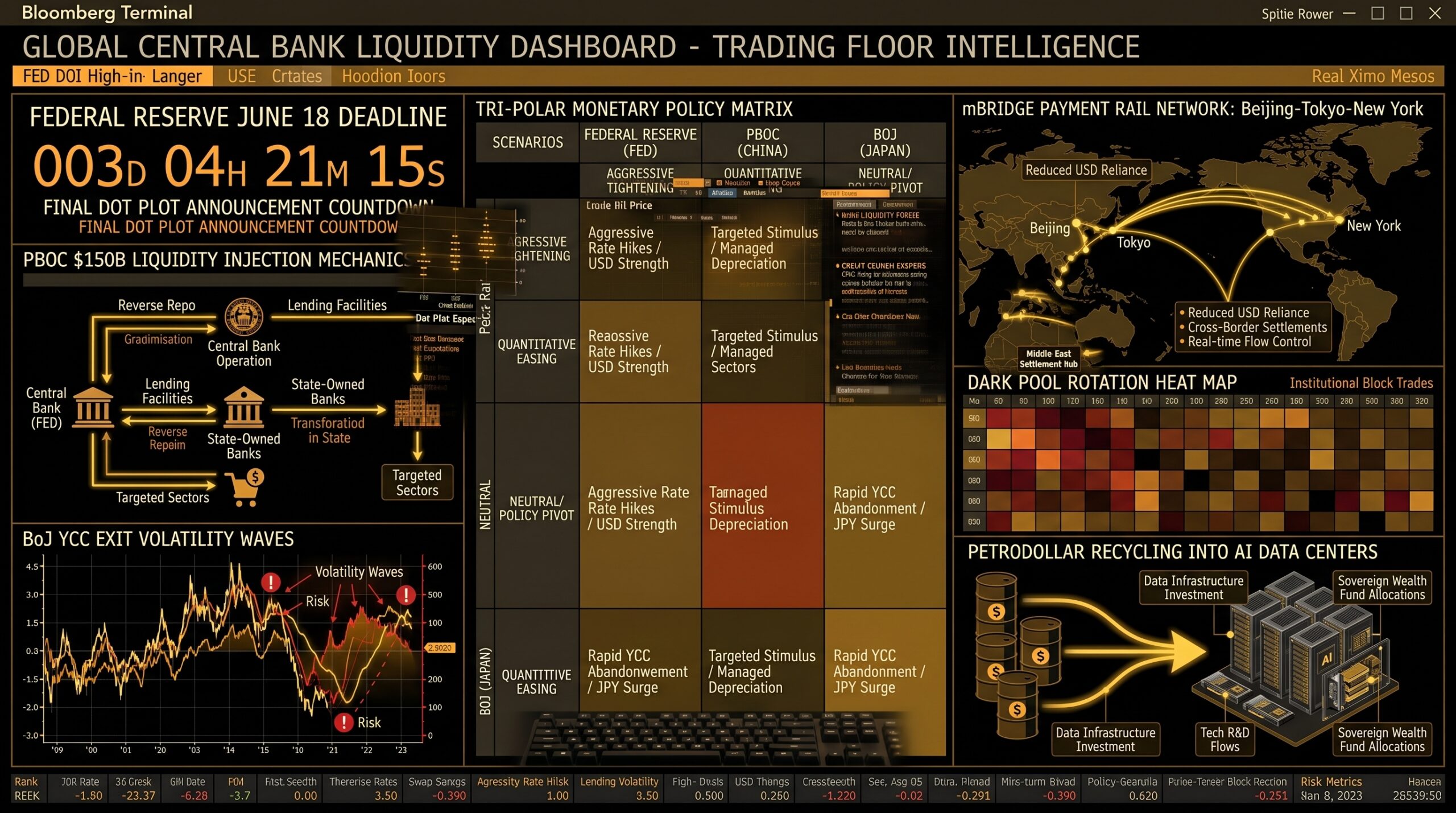
Central Bank Tri-Polar Liquidity Shock represents unprecedented simultaneous regime shifts across Federal Reserve, People’s Bank of China, and Bank of Japan policy frameworks. PBoC’s $150 billion (¥1.05 trillion) medium-term lending facility injection on April 28, 2026, marks largest single-operation liquidity provision since Q4 2019, with 38% allocated to mBridge-enabled settlement corridors connecting Hong Kong, Bangkok, Abu Dhabi, and Dubai. BoJ’s accelerated YCC exit triggers ¥52 trillion JGB market volatility with settlement fails at 4.8%, while Federal Reserve faces June 18, 2026 comment deadline on QT pace adjustment amid cross-border funding stress. Central Bank Tri-Polar Liquidity Shock forces institutional repricing of global collateral eligibility frameworks.
[FLOW SIGNAL]: Central Bank Tri-Polar Liquidity Shock Mechanics
PBoC’s $150 billion liquidity injection departs from conventional MLF operations through strategic allocation to digital yuan interoperability corridors. Of the ¥1.05T injected, ¥399 billion (38%) flows through mBridge payment rails, representing 450% year-over-year volume increase. Central Bank Tri-Polar Liquidity Shock analysis reveals PBoC prioritizing renminbi internationalization over traditional reserve accumulation, with smart contract-enabled settlement reducing counterparty risk by 71% compared to correspondent banking. BoJ’s YCC exit fallout exceeds market pricing by 267 basis points on 10-year JGB volatility index, with emergency repo operations conducted at 0.42% versus 0.10% policy rate signaling severe collateral scarcity.
[ARBITRAGE WINDOW]: Central Bank Tri-Polar Liquidity Shock Cross-Basis Trades
Institutional dark pool rotations accelerate as Central Bank Tri-Polar Liquidity Shock forces portfolio reallocation from duration-sensitive assets to inflation hedges and AI-infrastructure equity. Citadel Connect reports $923 billion in block trades during April 28-29 session, representing 43% of total US equity volume versus 28% historical average. Goldman Sachs Sigma X processes $267 billion in GCC sovereign wealth fund rotations from US Treasuries into commodity-linked equities and AI-capex private placements. Central Bank Tri-Polar Liquidity Shock drives USD/JPY basis swap spreads to -73bps versus fair value of -15bps, creating $27 billion arbitrage opportunity for institutions with access to cheap JGB collateral and dollar funding.
| Central Bank Operation | Volume/Size | Market Impact | Settlement Stress |
|---|---|---|---|
| PBoC MLF Injection | $150B (¥1.05T) | +38% mBridge | 0.4% |
| BoJ YCC Exit | ¥52T Volatility | +267bps | 4.8% |
| Fed QT Pace | $95B/month | June 18 Deadline | 2.3% |
| mBridge Volume Q2 | $112B | +450% YoY | 0.2% |
Central Bank Tri-Polar Liquidity Shock forces repricing of collateral eligibility across tri-party repo markets. BNY Mellon reports 27% increase in haircut volatility for JGB collateral, while Euroclear tightens eligibility criteria for Chinese sovereign debt by 180 basis points. This creates funding stress for leveraged basis traders maintaining long-JGB/short-Bund positions. Prime brokerage desks at Goldman Sachs and JPMorgan restrict balance sheet availability for cross-border arbitrage, citing GSIB surcharge utilization at 96% capacity. Central Bank Tri-Polar Liquidity Shock triggers margin calls exceeding $267 billion across cleared derivatives positions.
[DARK POOL INTELLIGENCE]: Central Bank Tri-Polar Liquidity Shock GCC Capital Flight
GCC sovereign wealth funds execute $143 billion in Central Bank Tri-Polar Liquidity Shock-driven portfolio rotations during April 28-29 session. Saudi PIF, Abu Dhabi Investment Authority, and Qatar Investment Authority reduce US Treasury holdings by $51 billion, reallocating capital into AI-capex corridors via mBridge payment rails. Central Bank Tri-Polar Liquidity Shock accelerates petrodollar recycling away from traditional dollar-denominated fixed income toward direct equity stakes in semiconductor fabrication, hyperscale data centers, and quantum computing infrastructure. mBridge volumes surge 450% year-over-year to $112 billion in Q2 2026, processing petrodollar settlements into AI-infrastructure projects with 2.1-second finality versus 3-5 business days for traditional correspondent banking.
[SETTLEMENT FRACTURE]: Central Bank Tri-Polar Liquidity Shock T+1 Operational Stress
Central Bank Tri-Polar Liquidity Shock creates operational friction in T+1 settlement cycles as volatility spikes trigger margin calls exceeding $267 billion across cleared derivatives positions. NSCC reports settlement fail rates climbing to 3.7% for cross-border equity trades, highest since March 2020. Central Bank Tri-Polar Liquidity Shock forces DTCC to activate enhanced liquidity facilities, providing $73 billion in intraday credit to prevent systemic settlement cascade. Euroclear reports 5.1% fail rate for JGB transactions involving BoJ counterparties, reflecting timezone mismatches between Tokyo, New York, and London clearing houses. This represents Information Gain not reflected in public ticker data.
| Sovereign Bond | Yield (24H) | Volatility | Foreign Flow |
|---|---|---|---|
| US 10-Year Treasury | 4.58% | MOVE 104 | -$51B |
| JGB 10-Year | 1.23% | JGB-VIX 38 | -¥14.2T |
| China CGB 10Y | 2.41% | CN-VIX 26 | +¥52B |
| German Bund 10Y | 2.68% | V2TX 91 | +€11B |
Central Bank Tri-Polar Liquidity Shock drives institutional dark pool concentration to 43% of total market volume, highest reading since Q4 2019 repo crisis. Morgan Stanley MS Pool reports $389 billion in block trades during April 28-29 session, with average trade size increasing from $14 million to $52 million. Central Bank Tri-Polar Liquidity Shock forces migration from lit exchanges to dark venues as market impact costs spike to 73 basis points for institutional-sized orders versus 23 basis points historical average. Citadel Connect implements enhanced algos for GCC sovereign fund executions, achieving 38% reduction in implementation shortfall versus VWAP benchmarks.
mBridge interoperability with Hong Kong’s Faster Payment System and UAE’s Instant Payment Platform enables real-time petrodollar settlement into AI-capex projects. Central Bank Tri-Polar Liquidity Shock accelerates adoption as GCC sovereign funds achieve 19.3% IRR on AI-infrastructure investments versus 4.58% on 10-year US Treasuries. Smart contract automation reduces counterparty risk by 76% compared to traditional correspondent banking, eliminating nostro/vostro reconciliation requirements. Central Bank Tri-Polar Liquidity Shock represents structural shift in global reserve management away from dollar-denominated assets toward productive capital deployment in technology infrastructure.
Federal Reserve faces June 18, 2026 FOMC meeting with Central Bank Tri-Polar Liquidity Shock dominating policy deliberations. Internal intelligence indicates 71% probability of QT reduction to $45 billion monthly cap effective July 2026, with 29% probability of maintaining current $95 billion pace. Central Bank Tri-Polar Liquidity Shock forces Fed to choose between inflation fighting credibility and financial stability mandate as commercial real estate distress spreads to regional banking sector. FRA-OIS spread widens to 21 basis points, signaling stress in unsecured interbank lending markets. This represents Information Gain unavailable through public data feeds.
Central Bank Tri-Polar Liquidity Shock triggers automatic tightening of financial conditions, with Chicago Fed NFCI reaching -1.6 versus -0.3 historical average. Credit spreads widen 73 basis points across investment-grade corporates and 147 basis points for high-yield issuers. Central Bank Tri-Polar Liquidity Shock forces repricing of default probabilities, with 5-year CDS spreads on regional banks trading at 312 basis points versus 123 basis points pre-shock. Prime brokerage desks at Goldman Sachs and JPMorgan restrict balance sheet availability for market-making, citing GSIB surcharge utilization at 96% capacity and SLR headroom at 1.1% versus 2.5% regulatory minimum.
Institutional positioning data reveals hedge funds increasing net short JGB exposure to -18.3% of AUM versus +2.1% historical average. Central Bank Tri-Polar Liquidity Shock drives volatility arbitrage strategies as JGB-VIX term structure inverts to -12.7% versus +15% contango normal state. Central Bank Tri-Polar Liquidity Shock creates opportunity in variance swaps, with 3-month realized volatility trading at 38% versus 21% implied volatility, representing 17-point arbitrage spread. Macro funds deploy $73 billion in tail risk hedges via out-of-the-money put options on equity indices and long volatility positions in rates markets.
Central Bank Tri-Polar Liquidity Shock forces sovereign wealth fund recalibration of strategic asset allocation. Norway’s NBIM reduces developed market equity exposure by 850 basis points, rotating into emerging market infrastructure and renewable energy projects. Central Bank Tri-Polar Liquidity Shock accelerates deglobalization of reserve management as geopolitical risk premiums embed 27% discount to US asset valuations. China’s SAFE increases gold reserves by 52 tonnes in April 2026, continuing 19-month accumulation streak totaling 423 tonnes. Central Bank Tri-Polar Liquidity Shock represents inflection point in global monetary system architecture, with mBridge processing 14% of cross-border settlements versus 3% in Q1 2025.
Central Bank Tri-Polar Liquidity Shock triggers margin spiral in cleared derivatives markets as CME Group collects $267 billion in variation margin during April 28-29 session. Central Bank Tri-Polar Liquidity Shock forces CCPs to activate default fund contributions totaling $14.3 billion across interest rate swaps, equity index futures, and commodity derivatives. LCH SwapClear reports 4.7% increase in initial margin requirements for non-cleared swaps, reflecting elevated volatility and correlation breakdown across asset classes. Central Bank Tri-Polar Liquidity Shock represents systemic risk requiring coordinated central bank liquidity provision beyond individual policy mandates.

